
The Maturity Shift in Go-to-Market: Why execution excellence is no longer enough
💡 Most GTM teams are optimizing dashboards. Very few are redesigning systems. In a world where AI accelerates everything, fragmentation scales just as fast as clarity. The real advantage is no longer execution volume. It is operating model design. We unpack the maturity shift in modern go-to-market in our latest article. Give it a read and let us know how your GTM model is evolving
JDM Control
1/22/20262 min read
For years, go-to-market was treated as a launch discipline.
Campaigns. Channels. Assets. Dashboards.
But something fundamental is shifting. GTM is no longer about activity. It is about architecture.
The companies that recognize this early will build systems that scale. The ones that don’t will continue optimizing in silos and calling it growth.
Here is what is actually changing.
1. Learning speed is the new competitive advantage
In an AI-heavy, data-rich environment, information is not scarce. Feedback is not scarce. Content is not scarce.
What is scarce is learning velocity.
The companies that win are not the ones with the loudest launch. They are the ones that close the loop fastest.
Structured retros. Signal capture from the field. Pattern detection across objections. Tight feedback loops between Sales, Marketing, Product, and Customer Success.
If Sales hears the same objection ten times and Marketing finds out a month later, that is not a messaging issue.
It is an operating model issue.
High-maturity GTM teams implement structured signal reviews, with clear ownership and rapid decision cycles measured in days, not quarters.
2. Demand is not a campaign problem. It is a systems problem.
Growth rarely breaks because an idea was bad.
It breaks because the system cannot handle scale.
Paid acquisition, content engines, web experience, lifecycle flows. These are not independent functions. They are components of one demand architecture.
When teams optimize channels in isolation, friction is not accidental. It is designed into the system.
Channel-first decisions. Strong dashboards. Weak coordination.
Demand only scales when the system functions as one connected mechanism.
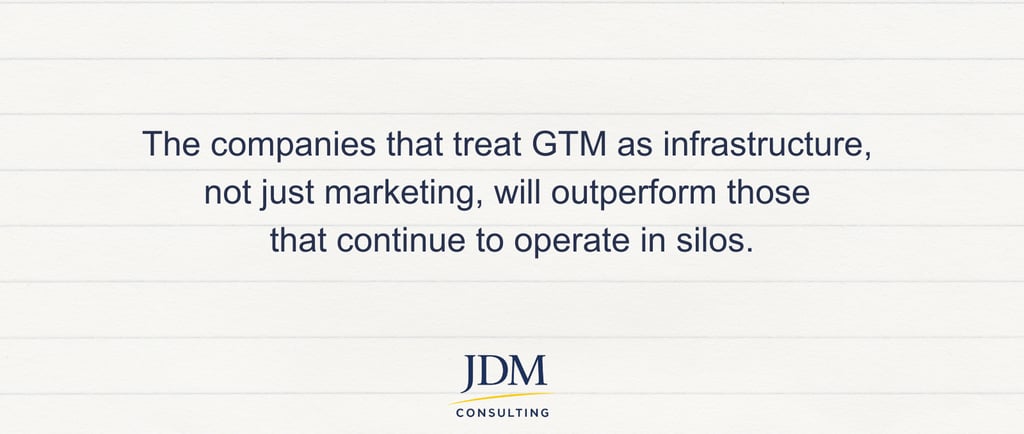
GTM is not a collection of tactics. It is infrastructure.
3. Alignment is not a slide. It is a shared economic anchor.
Many organizations believe they are aligned because every team reports green metrics.
But when those metrics cannibalize each other, that is not alignment. It is performance theater.
True alignment requires a shared economic anchor.
In practice, this means defining one shared revenue metric, aligning incentives across functions, and holding every team accountable to it.
When every function optimizes locally, the system fragments globally.
Alignment requires more than reporting discipline. It requires psychological safety to challenge good-looking KPIs that hurt the bigger picture.
4. Buyer behavior has fundamentally changed
Buyers are no longer guided through linear funnels.
They show up informed. Halfway through their journey. Often overwhelmed.
Information asymmetry is gone.
This changes the role of GTM.
It must shift from pushing messages to designing coordinated systems. From persuasion to orchestration. From convincing to guiding complex decisions with clarity.
Modern buyers do not need more information, they need coherence.
5. AI will amplify your operating model
AI is not the strategy. It is the multiplier.
If your GTM system is fragmented, AI will scale fragmentation. If your feedback loops are tight and alignment is real, AI will scale clarity.
AI can detect patterns across hundreds of sales calls faster than any human.
But detection is not advantage.
The advantage is how quickly insights turn into updated messaging, better qualification, smarter prioritization, and improved execution.
AI accelerates detection. It does not replace judgment.
In a world where content can be generated endlessly, coherence becomes the real differentiator.
Architecture matters more than volume.
The bigger shift
GTM is moving from execution excellence to system design excellence.
From campaign performance to organizational alignment. From activity metrics to learning velocity. From isolated functions to integrated operating models.
Organizations that treat GTM as coordinated infrastructure will outperform those that continue optimizing individual functions in isolation.
The shift is already happening. The question is whether your operating model reflects it?